Before HBS started work on the Google presence of Precision Consulting Engineering (PCE) at the start of 2026, 83% of the site's search impressions in the last seven weeks of 2025 came from planted Japanese spam pages that had nothing to do with the company. By 20 March 2026 those pages had disappeared from Google completely, and average daily clicks to the company's real pages had risen 51%. In this SEO case study we show how we spotted the hack in Google Search Console, the steps we took to clean the site, and the before and after numbers exactly as they appear in the site's own account.
Who is PCE and what was wrong with its website?
PCE is an engineering consultancy with more than 30 years of experience in infrastructure, construction management and project supervision across the Middle East, and its official site is pce-consultants.com. The problem was that the old WordPress site had been hit by what is known as the Japanese keyword hack, so Google was showing Japanese pages about video games, phone repairs and fashion under the company's domain instead of its projects and services.
According to Google's guide to the Japanese keyword hack, this hack creates new pages with autogenerated Japanese text on your site, and those pages are monetized with affiliate links to stores selling fake brand merchandise. For a serious engineering firm the result is a confused digital reputation and traffic with no value.
How did we spot the hack in Search Console data?
We spotted it in the Performance report of Google Search Console, because the numbers were clear to anyone who knew what to look for:
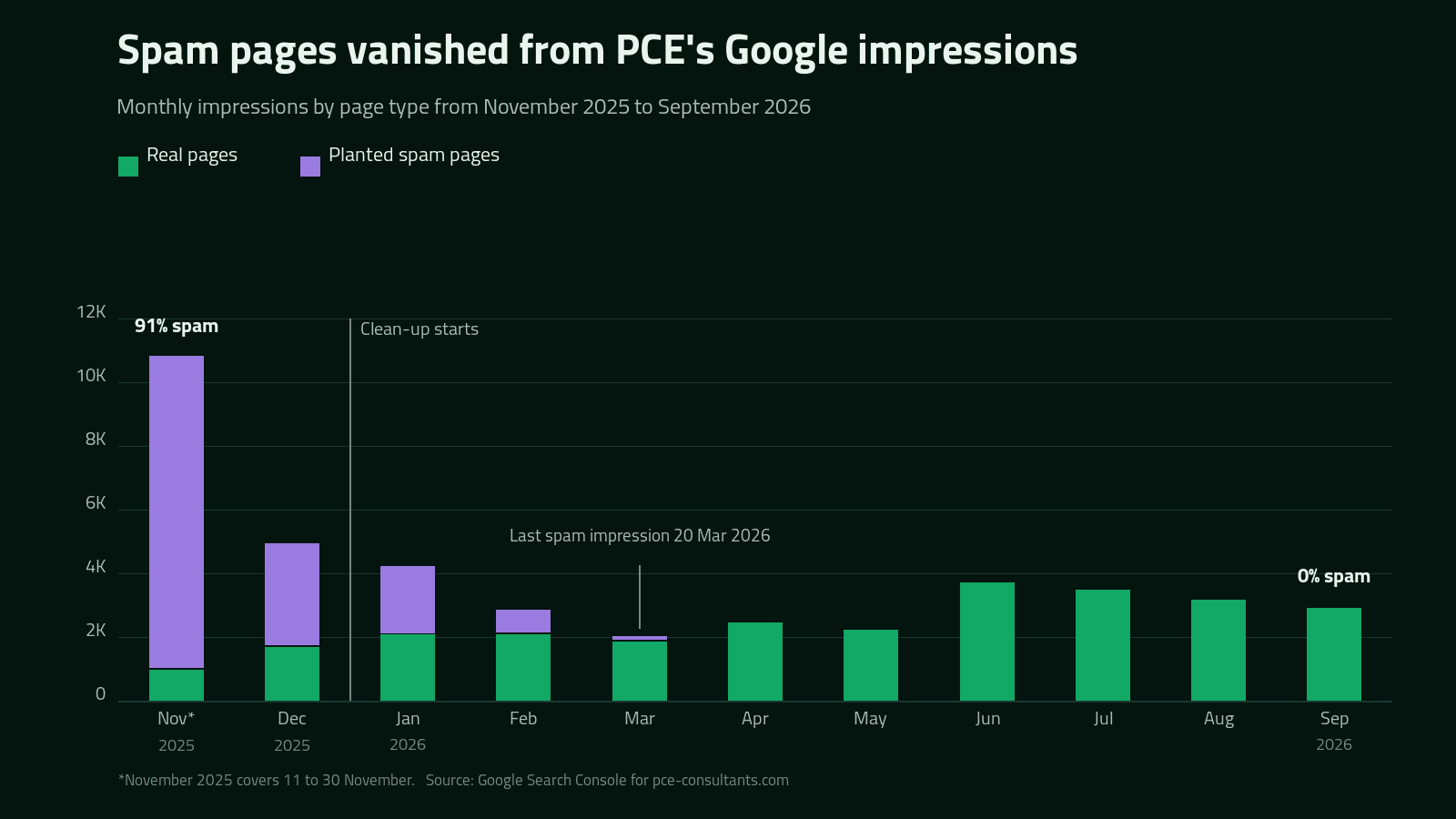
- In the first 20 days of data (11 to 30 November 2025), 9,809 of 10,774 impressions came from planted pages, or 91%.
- In the first 60 days the site appeared for 636 Japanese or Chinese search queries with no link to engineering.
- Japan was the second largest country by impressions after Egypt, although the company does not target the Japanese market.
- Among the 1,000 URLs with the most impressions, 931 were planted URLs with repeating patterns: long numbers ending in .htm, comment.php links and numbers after a question mark.
The lesson: do not wait for a warning message. The Performance report reveals this kind of hack early if you read it critically.
What steps did we take to clean the site?
We ran the clean-up in stages starting at the beginning of 2026. The goal was to make it clear to Google that the planted pages were gone for good and that the company now has a new, clean website:
- Map the damage: we sorted search queries and URLs in Search Console into three groups, the company name, general queries and planted pages, and identified every pattern of planted URL.
- A new site instead of the hacked one: we replaced the old WordPress site with a new site built on Next.js, with a dashboard that manages projects, services and job listings, so the site no longer depends on any file from the old version. See how we built the new site.
- A 410 for every planted URL: any URL that matches the hack patterns now returns status code 410, which means the page was removed permanently. Google's documentation on HTTP status codes explains that indexed URLs returning 4xx codes are removed from the index.
- A temporary sitemap of planted URLs: we sent Google a temporary file listing the planted URLs so it would revisit them and see they were gone, then removed it once it had done its job.
- Handle old WordPress pages: old URLs that have a match at the same address on the new site, such as the about and services pages, now open the new page, and anything without a match returns 410.
- A clean sitemap and clear signals: on 24 May 2026 we submitted the new sitemap with 83 pages, added canonical tags and structured data that describes the company and the site, and allowed AI search crawlers to reach the pages.
- Track it with numbers: we monitor planted URLs with a custom filter in the Performance report and follow the Page indexing report as the record of dead URLs shrinks.
What changed in the numbers before and after the clean-up?
The nature of the site's visibility changed completely: planted pages left the results, real impressions nearly doubled and clicks to the company's pages went up. We compared the period before the clean-up (11 November to 31 December 2025) with six full months after it (1 April to 30 September 2026):
| Metric | Before clean-up | After clean-up | Change |
|---|---|---|---|
| Share of impressions from planted pages | 83% | 0% | Gone |
| Real impressions per day | 52 | 98 | Up 89% |
| Daily clicks to real pages | 4.9 | 7.5 | Up 51% |
| Overall click-through rate | 2.1% | 7.6% | 3.6 times higher |
Other signals from the same account:
- Japanese and Chinese search queries: 636 in the first 60 days of data against zero in the last 60 days.
- Last impression for a planted page: 20 March 2026. No planted URL has appeared since that day.
- Google's record of non-indexed URLs: down from 303,022 URLs on 24 July 2026 to 91,659 URLs on 4 October 2026, a 70% drop in ten weeks.
- Clicks in 28 days: the site reached 150 clicks on 8 December 2025 and 250 clicks on 6 July 2026.
- Site health: no manual actions and no security issues in Search Console.
Why did total impressions fall while results improved?
Because a large share of the old impressions was fake. In November 2025 the site recorded 10,774 impressions, and 9,809 of them were for planted pages. After the clean-up no impression comes from a planted page anymore, so the total fell while real impressions per day rose from 52 to 98.
This matters when you read any SEO report: the bigger number is not always the better one. Always ask where the impressions come from and who is seeing your site.
How did the company's brand visibility improve in search?
PCE's name now appears in first place or very close to it in both Arabic and English, and clicks from brand searches rose 49% between the first 60 days and the last 60 days of data, from 202 to 300 clicks.
| Search query | Clicks | Average position |
|---|---|---|
| pce consultant | 544 | 1.4 |
| pce precision consulting engineering | 214 | 1.4 |
| precision consulting engineering | 187 | 1.3 |
| الدقة للاستشارات الهندسية | 53 | 1.5 |
| مكتب الدقة للاستشارات الهندسية | 7 | 1.3 |
The figures in the table cover the full period from 11 November 2025 to 9 October 2026. Between the same two 60-day periods, the number of brand queries ranking in the top three rose from 15 to 28. The query "pce" on its own has an average position of 4 and brought 306 clicks.
What is the next step for PCE in Google?
The next step is the general queries used by clients who do not know the company's name yet. The site now appears for Arabic queries such as "شركات استشارات هندسية" (engineering consulting companies), "استشارات هندسية" (engineering consulting) and "مكاتب استشارات هندسية في مصر" (engineering consulting offices in Egypt) at positions around eight and nine, but clicks from them are still low. The logical way to grow them is content that answers real client questions and links from trusted professional websites.
Google's record still holds about 91,000 dead URLs from the hack, and that is expected: according to Google's documentation, Google gradually stops using URLs that return 4xx codes and crawls them less often over time.
How can you tell if your site has the same hack?
Open the Performance report in Search Console and look for search queries in languages you do not target. That is the fastest sign. Others include:
- A country you do not serve appearing among your top countries by impressions.
- URLs with long numbers or an .htm extension that you did not create.
- A sudden jump in impressions with a click-through rate close to zero.
- Sitemap files you do not recognize, which Google's guide also warns about.
- A site: search for your domain in Google that shows pages in a strange language.
If two or more of these appear, start checking right away. After the clean-up, run through the six technical checks before any page goes live to make sure the new site is ready to be crawled and indexed.
Does your site need a clean-up or an SEO plan built on data?
If you notice any of these signs, or your Search Console numbers do not look like your real business, start by reading the data before choosing a fix. Learn more about HBS SEO services and custom web development.
Source: Google Search Console data for the pce-consultants.com domain from 11 November 2025 to 9 October 2026, plus live status code checks we ran on 11 October 2026.
Want to know exactly what your site shows up for in Google? Talk to us and we will go through your Search Console data with you on a free discovery call.