
Most business owners use "visual identity" and "brand" as synonyms, but they're fundamentally different concepts, and confusing them costs money. This guide explains the difference with practical examples so you know what your company actually needs before hiring an agency.
Why confusing the two terms costs companies money
Picture a business owner who asks for a "logo" for 5,000 EGP, then discovers months later that what they actually need is a full brand build for 50,000 EGP or more: colors, fonts, messaging, and a consistent tone of voice across every touchpoint. Confusing "visual identity" with "brand" makes you ask for the wrong thing, so you pay twice. Telling them apart is the first step to a sound investment.
What a brand is
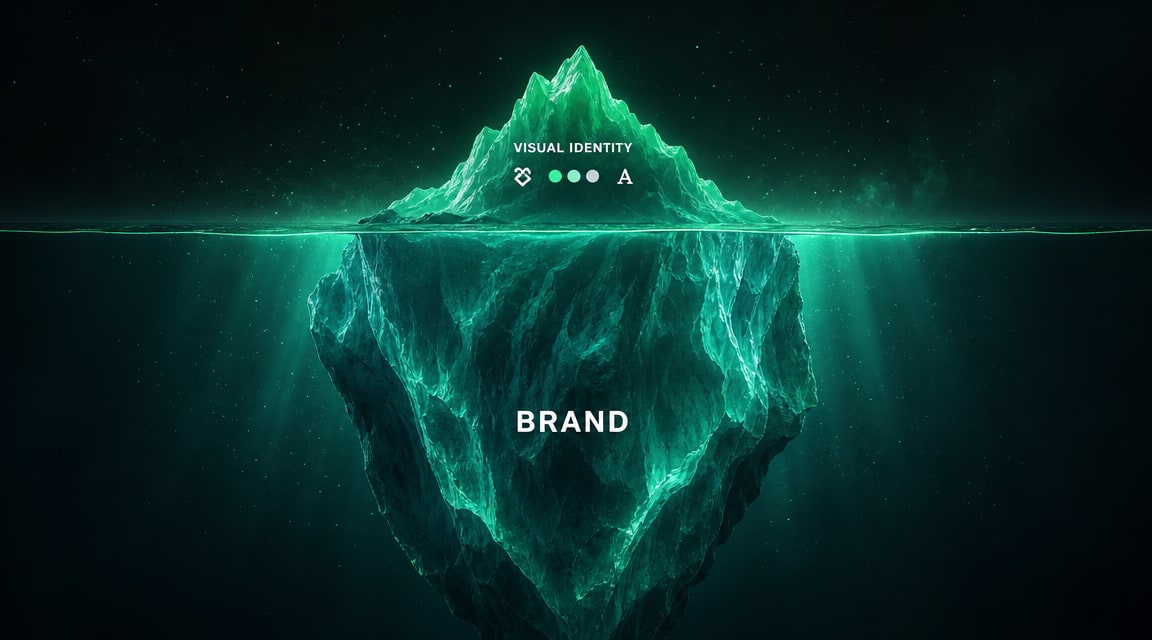
A brand is the total impression in a customer's mind of you. It isn't your logo. It's what people feel when they hear your name. It's shaped by everything: your product's quality, how you reply to a message, the buying experience, even how you handle a complaint. The brand lives in your customers' heads, not in a design file. And it is built on what those customers value: a Harvard Business Review study of more than 7,000 consumers found that, among people who say they have a relationship with a brand, 64% cited shared values as the main reason, far ahead of frequent interaction.
What a visual identity is
A visual identity is the visual system that expresses the brand: the logo, colors, fonts, icons, and graphic elements. It's the visible face, what your eye sees across the website, packaging, and social media. A designer creates and delivers the visual identity in files; the brand, by contrast, lives in the experience.
Visual identity vs brand at a glance
The direct comparison makes the difference clear:
| Aspect | Visual identity | Brand |
|---|---|---|
| What it is | The visible visual system | The total impression in the customer's mind |
| Includes | Logo, colors, fonts, icons, layout | Positioning, messaging, personality, voice, experience |
| Where it lives | In design files | In customers' heads |
| Who makes it | A designer creates and delivers it | Built over time by every interaction |
| Your relationship to it | You see it | You feel it and remember it |
| Changing it | Updates the look | Requires changing the experience |
The relationship between the two
The visual identity is the brand's face, but it isn't the whole brand. Their relationship is like a face to a personality: the face is the first thing you see, but it doesn't tell the whole story. A beautiful visual identity on top of a poor product or bad customer service doesn't build a strong brand. It just makes the disappointment clearer.
A worked example: Apple
Apple's visual identity is simple: the apple mark, clean lines, generous white space. But Apple's brand is far bigger than that: a feeling of creativity, quality, and deliberate simplicity in every detail, from product packaging to the store experience. Copy the apple mark literally and you still wouldn't have Apple's brand, because the brand is the sum of experiences and promises kept over years, not the symbol alone.
The elements of a complete brand
- Positioning: your place in the customer's mind versus competitors.
- Messaging: what you say and why it matters.
- Personality: are you formal, friendly, bold?
- Tone of voice: how you speak across every channel.
- Experience: every interaction from the first ad to after the sale.
The elements of a complete visual identity
- Logo: in all its formats and lockups.
- Colors: a primary and secondary palette with defined values.
- Typography: for headings and body, Arabic and Latin.
- Icons and graphic elements: a consistent visual language.
- Imagery and layout: photography style and rules for arranging elements.
When you need visual identity only vs. a full brand build
You need visual identity only if your positioning and messaging are already clear and you just want a consistent, professional look. You need a full brand build if you're launching something new, entering a competitive market, or sensing that people don't understand what sets you apart. The rule: if the problem is "we look unprofessional," it's visual identity; if it's "no one knows why we're different," it's brand.
The common mistake: thinking a new logo = rebranding
Many companies change their logo thinking they've "rebranded," then are surprised that nothing changed in customers' eyes. Changing the logo changes the face, not the essence. Real rebranding starts from positioning, messaging, and experience, and the new logo comes at the end as a reflection of them, not a substitute for them. If a new logo is genuinely part of your plan, our 10-step guide to professional logo design covers how to do it right.
Conclusion
Visual identity is what people see; a brand is what they remember and feel. The first is a face, the second a whole personality. Identify which of the two problems you have before you ask. It saves money and time. If you want to build a complete brand that starts from the essence and ends with a visual identity that expresses it, explore our branding service or get in touch for a free consultation.