
In the 30 days after Google dropped the old hacked pages from its index, LDY's website went from 284 Google impressions to 31,330, and clicks rose from 25 to 198. The site now shows up for 487 search queries instead of 15, and 235 of them have an average position in the top 10. In this SEO case study we show how HBS rebuilt LDY's website after it was hacked, the strategy behind it, and the before and after numbers exactly as they appear in the site's own Google Search Console account.
Who is LDY and why did its website need SEO work?
LDY (Labib Demian Youssef & Co.) has equipped laboratories in Egypt since 1962. It is the authorized agent for 12 global instrument brands, including METTLER TOLEDO and BUCHI, and serves more than 500 active labs from offices in Cairo and Dubai. Its official site is ldy-co.com.
The old WordPress site had three problems. It was hacked: when we audited it in May 2026, we found planted spam posts and links from a backdoor. It was hard to use, with leftover demo content from an unrelated theme and empty brand pages. And it had no real product catalog, even though LDY sells thousands of products. A lab manager searching for an exact balance or pH sensor model had no LDY page to land on.
How did HBS approach the project?
We started by listening, before writing any code. Over several meetings with LDY's team, we worked through the company's vision and the challenges it faced online.
One factor shaped every decision: LDY partners with some of the world's largest makers of laboratory and metrology instruments, including METTLER TOLEDO and BUCHI, and each partner has its own requirements for how its brand and products appear on a distributor's website. We studied those requirements one by one and designed the site around them.
From there we recommended a connected set of corporate tools instead of a website alone:
- A clean, fast website built for SEO from day one, with a page Google can find for every product.
- A dashboard for the marketing team to manage brands, products and content without waiting for a developer.
- A CRM for the sales team to follow up on the leads the website brings in.
On top of that we built an SEO strategy: a catalog structure Google can understand, a clean index, and clear signals that the hacked pages were gone. The numbers below are the result of that strategy.
What did Search Console show before the clean-up took effect?
Google still had the old hacked pages in its index, and it barely surfaced the site, mostly for the wrong pages. In the 30 days from 28 July to 26 August 2026:
- The site earned 284 impressions in total, about 9 a day, and 25 clicks.
- It appeared for only 15 search queries, and the largest by far was the brand name "ldy".
- All 25 clicks went to the homepage. No product page received a single click.
- Of the 43 URLs that appeared in Google in that window, 25 were planted spam URLs with patterns such as /?goods/, /commoditys/, /content.php?item/ and /?jp/, and 5 were old WordPress addresses.
- On 24 July 2026, Google's index still held 16,067 pages for the domain, most of them left over from the old, hacked site.
The commercial query that matters most for an authorized distributor, "mettler toledo egypt", sat at an average position of 55.
What steps did HBS take?
We treated it as two jobs at once: give Google a clean, well-structured site worth showing, and make it obvious that the old and planted pages were gone for good.
- Discovery and partner requirements: we documented every problem on the old site and every partner requirement, then planned the new information architecture around industries, brands and products.
- A new site instead of the hacked one: we replaced the compromised WordPress install with a new site built on Next.js, connected to the dashboard where LDY's marketing team manages brands and products. See how we built the new LDY website.
- One page per product model: every product has its own clean URL, for example /products/microgram-weight-single-0-5mg-c, a title in the format "Model | Brand | LDY CO", its own meta description, the model name as the H1 and a self-referencing canonical tag.
- Structured data: product pages carry Organization, WebSite, Product and BreadcrumbList markup so Google understands what each page is and where it sits in the catalog.
- Closing the old doors: the old WordPress paths (.php files and wp-content) now return 403, planted paths such as /commoditys/ and /detail/ return 404, and query-string variants point to the homepage with a canonical tag. Search Console now lists 238,300 URLs blocked with 403 and 5,170 returning 404.
- A clean sitemap: on 3 August 2026 we submitted the new sitemap, and Google read it successfully. The robots.txt file points to it and keeps internal paths such as /api/ out of search.
- Monitoring by the numbers: we track the Page indexing report to watch the old pages leave the index, and the Performance report by page and by query to see which products start to rank.
What changed in the numbers before and after?
We compared the 30 days before the index clean-up took effect (28 July to 26 August 2026) with the 30 days after it (31 August to 29 September 2026):
| Metric | Before | After | Change |
|---|---|---|---|
| Google impressions | 284 | 31,330 | 110x |
| Clicks | 25 | 198 | 7.9x |
| Search queries with impressions | 15 | 487 | 32x |
| Queries ranking in the top 10 | 7 | 235 | 34x |
| Queries ranking in the top 3 | 1 | 33 | 33x |
| Average position | 9.6 | 6.9 | 2.7 places higher |
| Pages with impressions | 43 | 829 | 19x |
| Countries with impressions | 44 | 140 | 3.2x |

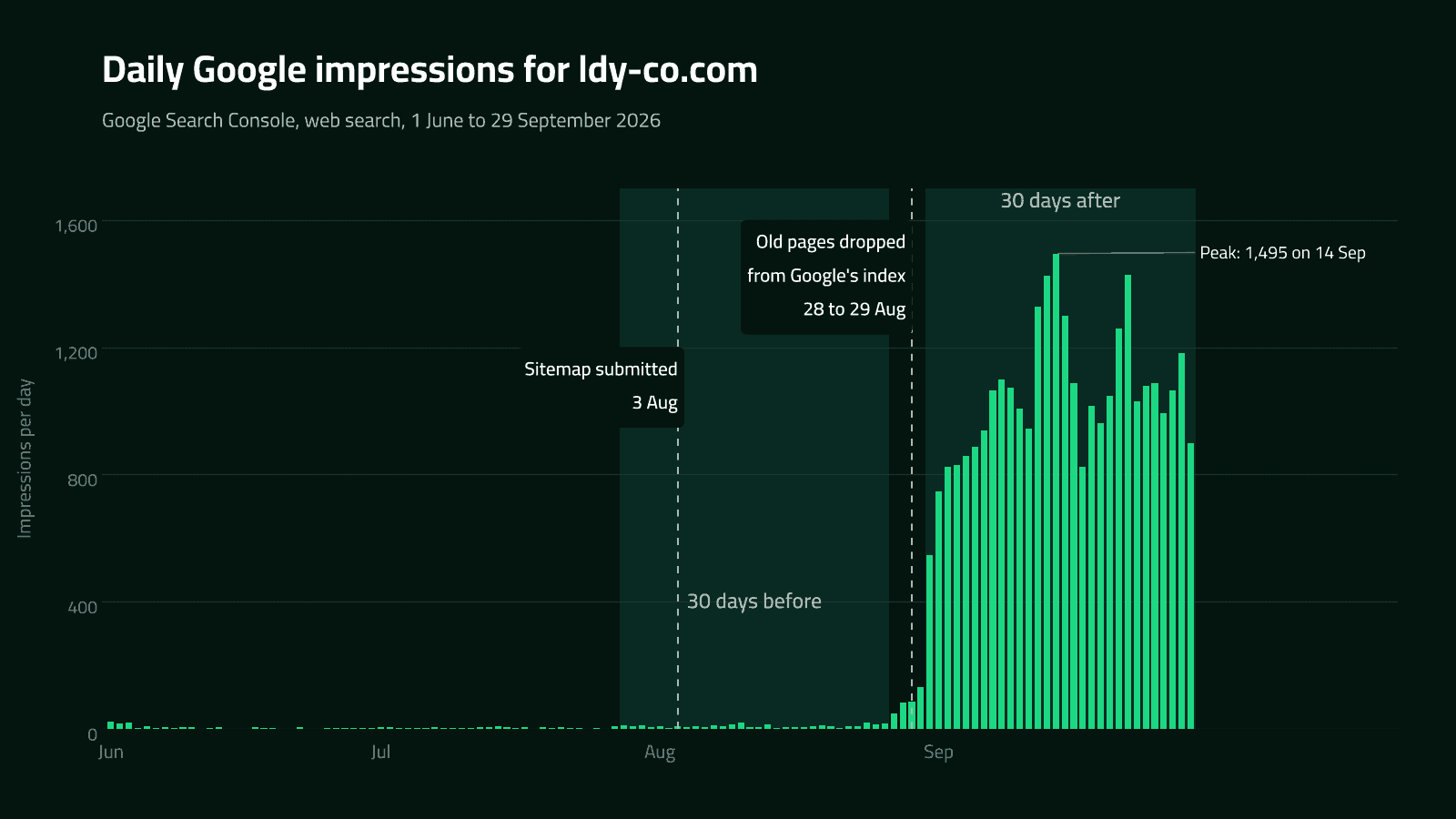
Daily impressions went from about 9 to more than 1,000, with a peak of 1,495 on 14 September 2026. Before, every click went to the homepage. After, the homepage received 31 clicks and product pages took the majority, led by load cells, user manuals and lab sensors.
Why did impressions jump at the end of August?
Because that is when Google finished dropping the old pages from its index. The Page indexing report shows the drop clearly:
- 24 July 2026: 16,067 indexed pages
- 28 August 2026: 8,952 indexed pages
- 29 August 2026: 3,325 indexed pages
- October 2026: 968 indexed pages, and 959 of them are product pages
Two days after the big drop, impressions climbed from 131 on 30 August to 548 on 31 August and 746 on 1 September, then stayed around 1,000 a day through September. We cannot see inside Google's systems, but the timing is hard to ignore: once the index stopped being dominated by spam and dead WordPress pages, Google started showing the real catalog.
The lesson for any site that was hacked: a smaller, cleaner index is not a loss. Fewer indexed pages went hand in hand with far more visibility.
Which searches does LDY appear for now?
LDY now appears for the exact model numbers that lab buyers and engineers type into Google. Here are examples from the 30 days after the clean-up:
| Search query | Impressions | Average position |
|---|---|---|
| microgram weight single 0.5mg c | 3,839 | 2.9 |
| gold balance jet2002g/00 | 3,760 | 7.3 |
| gold balance je1002g | 2,758 | 4.5 |
| handle kits quickflow w/s unv en | 941 | 1.3 |
The single strongest page is the product page for a 0.5 mg microgram weight, with 7,757 impressions at an average position of 3.6. The move that matters most commercially is on "mettler toledo egypt": its average position went from 55 to 1.8, and it is exactly the search a buyer makes before asking for a quote.
What is the next step for LDY?
The next step is turning this visibility into leads in LDY's core markets, Egypt and the Gulf. The plan focuses on:
- Arabic content: pages and articles that answer the questions lab managers in Egypt and the Gulf actually ask, in Arabic.
- Stronger industry pages: more depth on the pharma, petrochemical and food lab pages so they rank for broader searches, not only model numbers.
- Old links: pointing any old WordPress URL that still has outside links to its closest new page.
How can you apply this to your own product catalog?
If you sell products with model numbers, these steps apply directly:
- Give every model its own page with a clean URL and a title that contains the model and the brand.
- Add Product and BreadcrumbList structured data and a canonical tag on every page.
- Submit a clean sitemap and check that Google reads it without errors.
- If your old site was hacked, close the planted paths with 403, 404 or 410 codes and watch the Page indexing report until they are gone.
- Judge results by clicks, queries and positions together, not by one number.
If your site was hacked, read our PCE case study on cleaning a Japanese keyword hack as well.
Does your product catalog show up in Google?
If buyers search for your products and find a distributor in another country, or nothing at all, the fix starts with the data. Learn more about HBS SEO services and custom web development.
Source: Google Search Console data for ldy-co.com from 29 April to 11 October 2026 (performance), the Page indexing and Sitemaps reports as of October 2026, and live checks of the site we ran on 13 October 2026.
Want to know which of your products Google actually shows? Talk to us and we will go through your Search Console data with you on a free discovery call.