The right real estate management system for your company brings three jobs into one place: the inventory of units and the live status of each one, the sales pipeline from the first enquiry to the contract and collection, and the management of leases, owners and maintenance after the sale. The nature of your business decides where the weight falls. A developer needs reservations, payment plans and instalments. A brokerage needs strong lead management and commissions. A property management company needs lease contracts, collections and maintenance requests. And in the Gulf, the system has to work alongside official platforms such as Ejar in Saudi Arabia and Ejari in Dubai.
In this guide we set out the core modules for each type of real estate company, what a sales system and a lease management system need, how the system lines up with official platforms, and what management should see every morning. We finish with a requirements list to prepare before you ask anyone for a quote.
What should a real estate management system do for your company?
No single real estate system fits everyone, because the workflow is fundamentally different for those who build, those who sell and those who manage. This table sums up what each type needs:
| Type of business | Core modules | Biggest risk without a system |
|---|---|---|
| Real estate developer | Unit inventory by project, building and floor, reservations and deposits, payment plans and instalments, contracts, and unit handover | Selling the same unit to two customers, or overdue instalments that nobody follows up |
| Brokerage | Lead management from every channel, matching requests with listings, viewings, and commissions | Leads lost between WhatsApp and phone calls, with nobody sure who followed up |
| Property management | Lease contracts and renewals, payment schedules and collection, maintenance requests, and owner reports | Leases that expire without renewal, arrears that pile up, and owners who do not know how their properties are doing |
Many companies combine more than one of these, such as a developer that manages its leased units after handover. In that case the system should be one system with one database of units and customers, not separate systems with data copied between them by hand.
What are the core modules of a real estate sales system?
Real estate sales are a long cycle with large amounts and many parties, so the system needs at least these modules:
- Unit inventory with clear statuses. Available, temporarily held, reserved with a deposit, sold and handed over, with a log of who changed each status and when.
- Leads from every channel. The website, property portals, WhatsApp, ads and calls in one list, with the source of each lead and the person responsible for following up.
- Reservations with a set deadline. A temporary hold that expires automatically if the deposit is not paid, so no unit stays blocked for no reason.
- Payment plans and instalments. A down payment and instalments with dates and amounts, alerts before each due date and after any delay, and a statement of account for every customer.
- Contracts and documents. Contract templates filled from system data, with ID copies and documents stored in the customer file under defined access permissions.
- Commissions. The broker's or salesperson's commission calculated automatically once its conditions are met, not from a separate spreadsheet at month end.
If most of your enquiries arrive on WhatsApp, connecting it to the system saves your team from copying conversations by hand. We covered the options for that integration in our WhatsApp Business API playbook for Egypt, KSA and the UAE.
What does lease and property management need?
Property management is repeat work every month, and any small error in it multiplies with the number of units. So the system needs:
- A register of lease contracts. Start and end dates, value and payment terms, with an early alert before each lease ends to start a renewal or a move-out.
- Payment schedules and collection. Due, collected and overdue payments for every unit and every owner, with automatic reminders to tenants.
- Maintenance requests. A request opened by the tenant or a staff member, assigned to a technician and tracked until it is closed, with its cost and who it is charged to.
- Owner reports. A regular report for each owner showing occupancy, collections, expenses and the net amount due to them.
- A portal for the tenant or owner. Where they can see their contract and payments and open a maintenance request without a phone call.
The more units you manage, the more this automation is worth: follow-up that takes an hour with twenty units takes days with hundreds, and every mistake costs more.
How does the system line up with official platforms in the Gulf?
In Saudi Arabia, as things stand (November 2026), the Real Estate General Authority regulates the rental market through Ejar, as well as real estate brokerage, off-plan sales and leasing, and owners' associations, through its platforms. In Dubai, tenancy contracts are registered through Ejari, run by the Dubai Land Department, and its Ejari registration and renewal service page lists the channels, required documents and fees.
Your internal system does not replace these platforms, but it has to work with them consistently:
- Store the official reference for every contract. The registered contract number, its registration date and its end date, inside the unit and customer files.
- Tie reminders to the official dates. An alert before each renewal date, early enough to finish the procedure on the platform.
- Make the status in your system reflect the official status. Do not show a unit as leased before its contract is registered, or as available before the contract is ended.
- Use automated integration where the authority offers it. Otherwise, a clear data entry step with defined permissions beats relying on memory.
- Review the requirements with your adviser. Brokerage, advertising and off-plan rules keep changing, so keep the system flexible enough to add new fields and procedures.
What should management see in the real estate management system every morning?
A good system answers management's questions directly, without waiting for a manual report:
| The question | The indicator |
|---|---|
| What is left to sell? | Available, reserved and sold units by project and unit type |
| Are we answering customers quickly? | Enquiries nobody has opened yet, and the average time to first response |
| Which channel brings real customers? | The conversion rate from enquiry to reservation for each channel |
| How much money are we expecting? | Instalments and rents due this month, and those past their due date |
| Are our leased units performing well? | Occupancy rate, leases ending soon, and open maintenance requests with their age |
Each of these indicators should open, with one click, the list behind it, so a manager can move straight from the number to the action: from the count of overdue instalments to the customers' names and who is following up each one.
What are the common mistakes when choosing a real estate management system?
- Starting from the feature list instead of the workflow. A system with a hundred features does not help if it does not follow the way you actually reserve and collect.
- Splitting sales and leasing into two systems. The full picture of the unit and the customer gets lost, and everything is entered twice.
- Neglecting permissions. An external broker should not see all your inventory, prices and customer data, and a new employee should not be able to edit contracts.
- Migrating old data as it is. Duplicate units, customers with several numbers and outdated instalments spoil the new system from day one, so clean them before the move.
- Relying on manual reminders. Instalment dates and lease renewals should be flagged by the system automatically, not by one employee's memory.
What requirements should you prepare before asking for a quote?
Before you contact any vendor, write your answers to these points on a page or two, because they define the scope of the project and its cost:
- Your type of business and your number of projects and units. Today and in three years.
- Users and their roles. Sales, accounts, property management, technicians and external brokers, and what each of them can see.
- Languages. Arabic and English, or more languages if your customers come from different nationalities.
- The channels to connect. Your website, property portals, WhatsApp, payment methods and accounting system.
- The official platforms you deal with. And which data from them must be kept in the system.
- Your current data. Where it lives today, in Excel sheets or an old system, and who will clean it before the move.
- Where data is hosted and how it is protected. Especially if you have local requirements for personal data protection.
If you are still comparing a ready-made real estate system with one built for you, first read our article on building a custom system or buying ready-made software. And if you are not yet sure which core system you need, start with our article on CRM vs ERP.
How does HBS approach real estate management systems?
At HBS we start from the customer's journey and the unit's journey as they really happen in your company: where the enquiry comes from, who answers it, when the unit is reserved, how the money is collected, and what happens after handover. We then build the system around that journey, and give your team full control of the content and data without waiting for a developer.
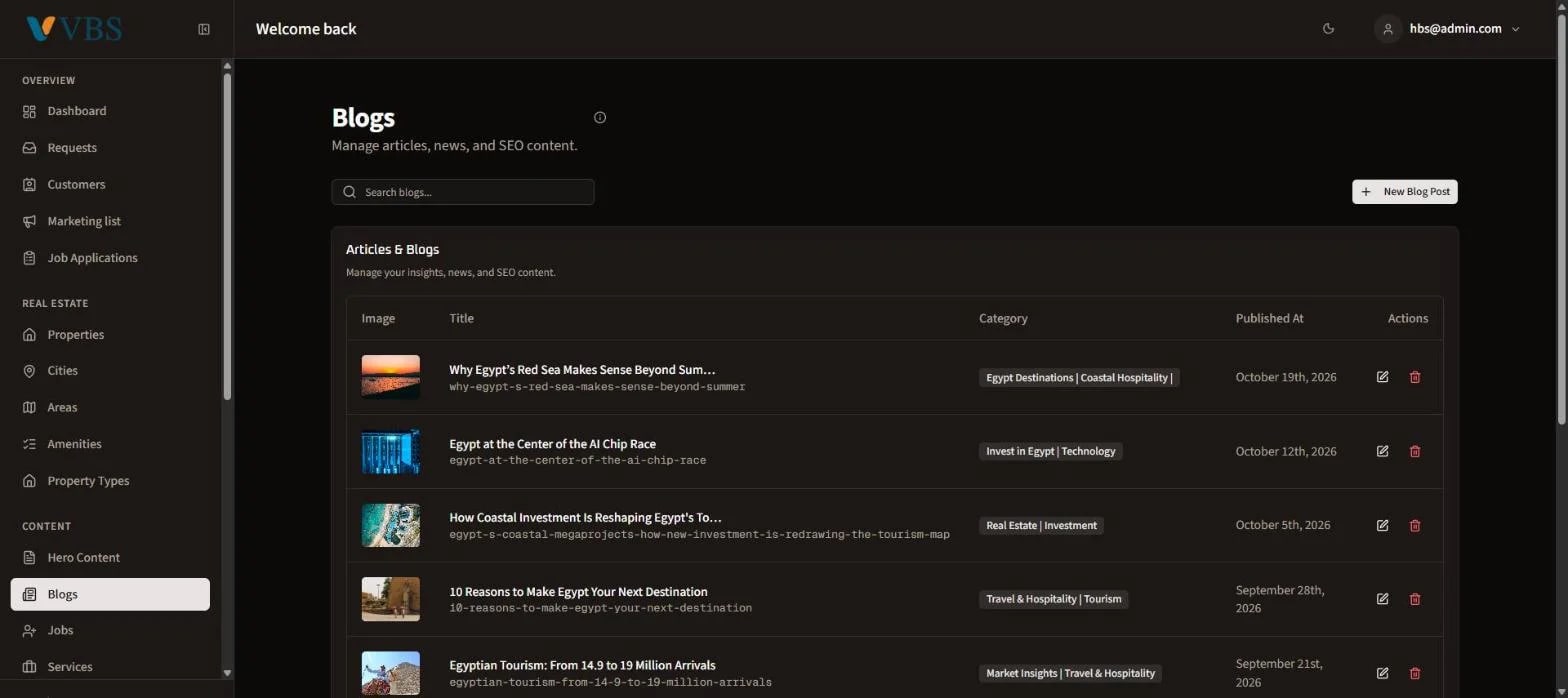
An example from our work: the operations and CRM dashboard for Venus Business Solutions (VBS), which helps foreign investors and residents buy property and invest in Egypt. Every property or investment request that arrives from its website, in any of five languages, becomes a tracked request with clear stages in the dashboard, with indicators that show requests nobody has opened yet and the average time to first open, and requests are grouped automatically into customer profiles with a badge for returning customers.
On the property side, the team runs a full portfolio from one table showing the cover photo, type, purpose, city, area, price and currency, with a switch that takes a listing live or back to draft instantly, and a tabbed editor for the basic details, descriptions in five languages, location, photos and amenities. The dashboard is built on Next.js and TypeScript, with Supabase for the database, authentication and storage, and a five-language content model shared with the public website. The result is a team that runs the property catalogue and the whole website without a developer.
Legal details and fees in this article reflect the situation in November 2026 and may change; check the official source before you decide.
If you run real estate projects or a rental portfolio and you are still working between Excel and WhatsApp, tell us how you work from the first enquiry to handover and collection. We will sit down with you in a free discovery session and tell you honestly which system fits, and you can learn more about HBS custom real estate and sales management systems development.