A software requirements specification (SRS) is a document that describes what a system must do, for whom and why, before anyone decides how it will be built. You do not need a technical background to write one: ten short sections in the language of your daily work are enough to get quotes you can compare, a clear scope you can hold your development team to, and a faster start for any project.
This guide gives you a practical template with the sections you need and what to write in each, explains how to write requirements a developer can understand and test, lists the requirements most business owners forget, then shows a real example from HBS work and a checklist before you send the document.
What is a software requirements specification and why write it before asking for quotes?
In software engineering this document is called a Software Requirements Specification, and the international standard ISO/IEC/IEEE 29148 for requirements engineering defines its content in full technical detail. As a business owner you do not need the technical version. You need a business-side version that describes the problem, the users, the processes and the results you want, which the development team then turns into technical specifications and design.
Writing it before you contact any developer gives you four direct benefits:
- Quotes you can compare. When the same document reaches every company, the differences between quotes are differences in price and approach, not in how each company understood what you want.
- A scope you can hold people to. What you wrote in the specification becomes the basis of the scope in the quote and the contract.
- Internal agreement before spending. Many disagreements between departments surface while writing, and settling them on paper costs far less than settling them in code.
- A shorter discovery phase. A team that starts from a written document spends its time on the hard questions, not on gathering the basics.
Which sections should the specification contain?
Use this table as a template and fill it in section by section. The examples in the last column are illustrative, from a hypothetical distribution company. Replace them with what happens in your business:
| Section | What to write | Short example |
|---|---|---|
| Company and problem | Who you are, what does not work today, and what it costs you | Quotes are written in Word and follow-up gets lost between email and WhatsApp |
| Goals and success criteria | What must change, and how you will know it has changed | Issue a quote on the same working day and know the status of every quote |
| Users and roles | Who will use the system, how many, and what each role sees and edits | Sales, service, manager, and a read-only viewer for senior management |
| Workflows | Processes step by step as they actually happen, not as they should happen | Inquiry, then visit, then quote, then negotiation, then purchase order |
| Functional requirements | What the system must do, ordered by priority | Create a quote in several versions and send it from inside the system |
| Data and reports | The data you have today and where it is, and the reports you need, by name | An Excel file of customers, and a monthly performance report per sales rep |
| Integrations | The systems it must connect to, by name | The accounting software, the e-invoicing system, email |
| Non-functional requirements | Languages, devices, security, hosting and expected number of users | Arabic and English, works on mobile, daily backups |
| Constraints and timeline | Key dates, rough budget, and what cannot change | Live before the start of the financial year |
| Out of scope | What you do not want in this phase | The mobile app is postponed to a later phase |
The specification does not need to be long. Ten clear pages are more useful than fifty general ones. What matters is that each section answers its question with examples from your real work.
How do you write functional requirements a developer can understand?
The most confusing requirements are the general ones, such as "an easy system" or "comprehensive reports". The fix is to write each requirement as a user story, then add an acceptance criterion that can be tested:
- The user story format. "As a [role], I want to [do something] so that [I get a result]." Example: "As a sales rep, I want to create a quote from the product catalogue so that I do not type prices by hand."
- The acceptance criterion. A sentence that defines when the requirement is done. Example: "The quote calculates the discount and VAT automatically, and every edit is saved as a new version."
- The priority. Put each requirement in one of four groups: must have for launch, important, nice to have, and not now. This grouping is what lets you and the development team split the project into phases.
- A number for each requirement. A simple ID such as "R12" makes it easy to discuss in meetings, quotes and testing without confusion.
If your "must have for launch" list is very long, that is a sign the first phase is bigger than it should be. And to decide whether the system should be built at all, or whether ready-made software is enough, see our comparison of building a custom system versus buying ready-made software.
Which requirements do most business owners forget?
These items rarely come up in the first meeting, but they change the size and cost of the work when they appear late:
- Detailed permissions. More than "admin and user": what each role sees, what it edits and what needs approval before it happens.
- Moving old data. Where it is today, in what format, how many years of records must move, and who will clean them.
- Arabic everywhere. Text direction, search in Arabic, printed invoices and quotes, and customer names in Arabic and English.
- E-invoicing. If your company is required to use it in Egypt, state that the system must connect to it according to the official integration documentation for Egypt's e-invoicing system.
- Notifications. Who is alerted, when, and through which channel: inside the system, by email or on WhatsApp.
- An activity log. Do you need to know who changed what and when? In finance and admin systems the answer is usually yes.
- Backups and hosting. Where the data is stored, how often it is backed up, and in whose name the servers are registered.
What are the common mistakes when writing a requirements specification?
- Describing the solution instead of the problem. "We want a green button at the top of the screen" boxes the team in. "The sales rep needs to see overdue quotes as soon as they log in" leaves them free to choose the best way to do it.
- Copying a competitor's system as it is. What suits another company may not suit the way you work. Describe your own work, not someone else's screens.
- Having one person write it. A manager sees the process from above, and the person who runs it every day knows its exceptions. Bring both into the writing.
- Mixing the essential with the desirable. When everything is essential, the first phase grows, launch slips and cost rises.
- Treating the document as final. It is a starting point that improves during discovery, so keep one up-to-date version that everyone refers to.
What does a requirements specification look like in a real project?
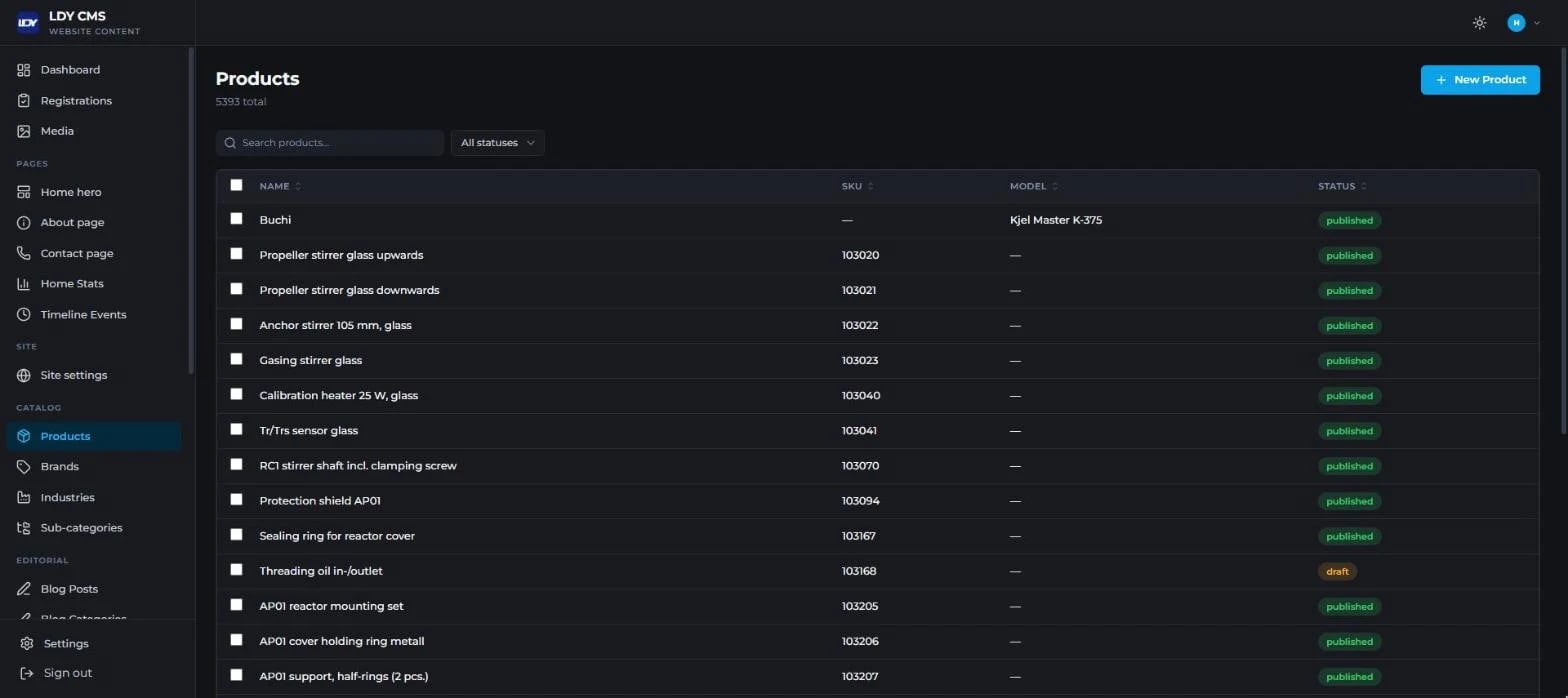
The clearest way to understand a specification is to see written goals turn into parts of a system. That is what happened in the LDY CMS dashboard we built for Labib Demian Youssef & Co., the authorised agent for 12 global laboratory instrument brands. The project's business goals were written in business language, and each one became specific modules:
| Business goal | What it became in the system |
|---|---|
| One place for accounts, contacts, deals, quotes and follow-ups | An account view that brings all of it together, and a sales pipeline that follows the company's real sales stages |
| Turn website and partner leads into tracked opportunities | An inquiries inbox with statuses and owners, and one-click conversion into an account and a deal |
| Professional quotes, fast | A quote builder with discounts, 14% VAT as things stand (November 2026), terms and versions |
| After-sales service in the same system as sales | Installed equipment, warranties, service tickets, maintenance contracts and calibrations |
| Clear visibility for management, with control over who sees and changes what | Fourteen ready reports, a permissions matrix with five roles, and a full audit log |
| Fast adoption by the team | On-site training, live webinars and short Arabic video tutorials for every module |
Notice that the last goal is not a software feature at all, yet it was part of the delivery. That is exactly what a good specification does: it describes the result you want, not only the screens.
At HBS our projects start with a discovery phase before any design or code. If you send us a requirements specification, it becomes the starting point: we review it with you section by section and turn it into a phased scope. If you do not have one, we gather what you need with you in that same phase.
What should you check before you send the specification?
- Can someone outside your company understand it? Give it to a colleague who does not know the project and ask what the system will do.
- Does every goal have a way to measure it? "Better follow-up" cannot be measured. "Knowing the status of every quote at any time" can.
- Are all roles listed with their numbers? The number of users in each role affects design and cost.
- Does every requirement have a priority and a number? Without them the project cannot be split into phases.
- Are integrations named by system? Not "other systems" in general.
- Did you attach real examples? A sample invoice, a report you use today, and screenshots of your current Excel files with sensitive data hidden.
- Did you write what is out of scope? This section prevents expectations nobody agreed to.
- Has everyone who will use the system approved it? One owner from each department reads it and confirms it describes their work.
Once quotes arrive based on your specification, the reading and comparison stage begins. We cover it in our guide on how to read a software development quote line by line before you pay.
Legal details and fees in this article reflect the situation in November 2026 and may change; check the official source before you decide.
If you have an idea for a system and are not sure where to start with the requirements, send us what you have written, even if it is a single page. Our team will sit down with you in a free discovery session and help you complete the picture, and you can learn more about HBS custom business software development.