
Building a SaaS platform goes through eight steps: validating the problem with real customers, defining the scope of the first version, choosing how to separate each customer's data, designing plans and billing, building the shared core, then security and compliance, a closed beta, and a launch where you measure everything. Most of the cost does not come from the features customers see, but from the core they never see: multi-tenancy, permissions, billing and the platform admin console, plus monthly running costs that continue after launch.
This guide explains how building a SaaS platform differs from building a system for one company, then sets out the steps in order, the ways to separate customer data, what drives the cost, the Gulf market requirements to build in from the start, and the mistakes that keep repeating on these projects.
How is building a SaaS platform different from building a system for one company?
An internal system serves one company that knows its users by name. A SaaS platform is a product you sell by subscription to dozens or hundreds of companies, each with its own data, settings and users. That changes how you build from the ground up:
| Aspect | Internal system for one company | SaaS platform |
|---|---|---|
| Customers | One company and its users | Many companies, each with its own workspace |
| Data | One database for one organisation | Strict separation so no customer can see another's data |
| Revenue | A cost the company carries | Subscriptions, plans, invoices and automatic renewal |
| Onboarding | Training led by the development team | Self-service sign-up and setup that must work without help |
| Updates | Coordinated with one company | Reach every customer at once and must not break anything for anyone |
| Measure of success | Time and cost saved inside the company | Customers who pay, stay and renew |
What are the steps to build a SaaS platform from idea to launch?
This order lowers the risk, because each step tests an assumption before you pay for the next one:
- Validate the problem with the people who will pay. Talk to potential customers about how they work today and what the problem costs them, and ask for a concrete commitment such as a paid pilot or a letter of intent. We cover idea validation tools in our article on starting a company with AI, from idea to launch.
- Define the scope of the first version. One workflow that solves the core problem from start to finish, not ten half-finished features.
- Choose how to separate customer data. This is an architectural decision that is hard to change later, and we explain it in the next section.
- Design plans and billing. What each customer gets on each plan, how the invoice is calculated, and what happens when a payment fails or a free trial ends.
- Build the shared core. Sign-up and sign-in, workspaces, roles and permissions, notifications, an activity log, and the platform admin console you use to manage every customer.
- Secure the platform and follow the data rules. Encryption, backups and error monitoring, and where the data is hosted for the markets you serve.
- Run a closed beta with real customers. A limited number of companies use the platform in their daily work while you watch where they get stuck and where they need help.
- Launch and measure. The share of sign-ups who finish setup and reach a first result, the share who cancel, and monthly recurring revenue, then develop based on those numbers.
To estimate how long each phase of the build takes, see our guide to how long custom software takes to build.
How do you separate each customer's data?
Developers call this multi-tenancy, and there are three common approaches that differ in isolation and running cost:
| Approach | How it works | Advantages | Limits |
|---|---|---|---|
| Shared database | All customers sit in the same tables, and every record carries the customer's ID | Lowest running cost and easiest to update | Any mistake in data filtering can expose one customer's data to another, so it needs strict testing |
| Separate schema per customer | One database, but each customer has its own set of tables | Better isolation at a moderate cost | Every update runs across each schema, which adds complexity as customers grow |
| Database per customer | Each customer has a fully independent database | The highest isolation, suited to large customers and local hosting requirements | The highest cost and the most work in operations and monitoring |
Many platforms start with a shared database and strict data-level controls, then offer a dedicated database as an option on the top plan. What matters is making the decision deliberately at the start, not discovering it once you already have a hundred customers.
What drives the cost of building a SaaS platform?
No single number fits every platform, but the cost moves with factors that are mostly in your control:
| Factor | What pushes cost up | What brings it down |
|---|---|---|
| First version scope | Many features before the first paying customer | One complete workflow |
| Data separation | A dedicated database per customer from day one | A shared database with strict controls and a later upgrade option |
| Billing | Complex usage-based pricing in several currencies | Clear monthly and yearly plans |
| Integrations | Connections to many systems for each customer | A public API and a few core integrations |
| Platforms | Native mobile apps alongside the web from the start | A responsive web app first |
| Languages and markets | Many languages and countries with different tax rules | One market and two languages at the start |
Remember that the platform keeps costing money after launch: cloud hosting that grows with your customers, payment gateway fees on every transaction, email and SMS services, error monitoring, customer support and continued development. Build these costs into your pricing model from the start, so operations do not eat your margin. Set aside a budget for sales, marketing and customer success too, because this is daily work that does not end at launch, and many good platforms stall because the whole budget went into the build with nothing left to reach customers.
Which Gulf market requirements should you build in from the start?
If your platform targets Saudi Arabia and the Gulf, these requirements belong in the foundation, not in a later add-on:
- A real right-to-left Arabic interface. Not a translation of an English interface, but a design that handles the direction of tables, numbers, dates and fonts.
- Invoices that meet e-invoicing rules. If you issue invoices to customers in Saudi Arabia, review the ZATCA e-invoicing requirements before you design the billing module.
- Where the data is hosted. As things stand (November 2026), Saudi Arabia's Regulation on the Transfer of Personal Data Outside the Kingdom, published in the Umm Al-Qura gazette, sets the conditions for transferring personal data outside the country, so review it with your legal adviser before you choose a hosting region.
- Local payment methods. Local cards such as mada and regional payment gateways, not international cards alone.
- Support in Arabic. A help centre, tutorial videos and system messages all in Arabic, because a customer who does not understand the platform does not renew.
What are the common mistakes when building a SaaS platform?
- Building everything before the first paying customer. Months of development on assumptions nobody tested, then finding out customers want something different.
- Postponing the data separation decision. A platform built for one customer and then opened to others usually needs large parts rebuilt.
- Manual billing. Bank transfers and phone follow-ups can work with ten customers, but they collapse at a hundred.
- No platform admin console. Without one, every change to a customer's account needs a developer working directly in the database.
- Neglecting onboarding. A customer who does not reach a first result in their first days rarely comes back.
- Building the platform on code you do not own. If the platform is your product, owning the code is essential, and we explain what the contract should include in our guide to software development contract clauses.
Should you build the platform with an in-house team or a development partner?
An in-house team gives you full control and knowledge that stays in your company, but it takes time to hire and costs a fixed amount every month, even before you know whether the product will work. A development partner gives you a complete team from day one, with prior experience building the shared core, but it needs a decision-maker inside your company who owns the product vision and sets priorities.
A path that suits many founders is for the development partner to build the first version and the core, while you gradually build a small in-house team that takes over the knowledge and leads the product after launch. This only works if the contract is clear on code ownership, documentation and knowledge transfer, and if the code is written in a way another team can build on.
How does HBS build SaaS platforms?
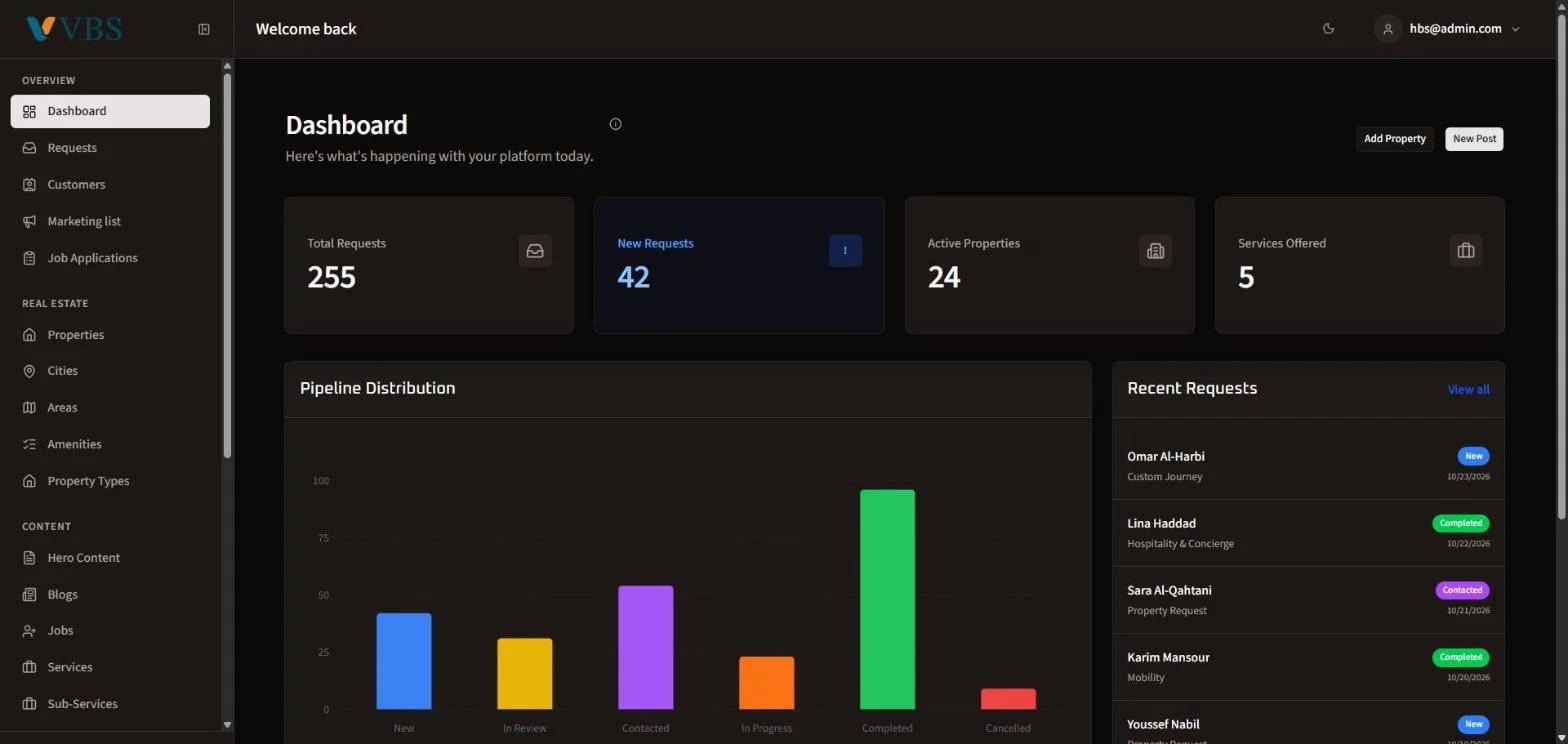
At HBS we start with the core before the features. On Waslah, a micro-systems marketplace where companies install small workflow tools and use them straight away, we first built a shared layer that powers every tool: multi-tenant workspaces with secure separation for each company, team and branch management, role-based permissions that apply across all tools, central notifications, and audit logs for sensitive actions.
On top of that we built the marketplace itself, with tool installation and configuration for each workspace and features tied to plans, an approvals engine shared by the tools, and a central admin console to control plans and users and follow the platform's adoption and growth. EstateNexus was the first tool on the platform, and it proved the idea in a real operational domain. Following the same logic, HBS Tech delivers HBS LMS to academies and trainers under each client's own brand, including the admin and analytics dashboard for Ali Bambozya's academy.
Legal details and fees in this article reflect the situation in November 2026 and may change; check the official source before you decide.
If you have an idea for a SaaS platform and want to know where to start and what to build first, tell us about the idea and the customers you are targeting. We will sit down with you in a free discovery session to define the scope of your first version and the build plan, and you can learn more about HBS SaaS and custom software development.